Policy-gradients for Poker
Abstract
Poker is usually solved with CFR-based methods and discrete abstractions. In this project the goal was the other way around. Do not treat Poker as discrete game, from which we remove some actions, but treat it as continuous-action game, which is then discretized during gameplay. This is project is part of my work on the paper Regularized policy gradient with learned mixtures of Gaussians for games with continuous actions, which extends the regularized policy-gradient algorithms to continuous action games.
Research notes
September 30, 2026
Decreased GAE lambda did not help. Quite the contrary it seems. It surprises me that the LRB drops sharply, but then after ~6 hours it stays largely the same, even if Slumbot performance improves. This is just weird, I am running some diagnostics to see what happens. I am doing off-policy exploration, so bad exploration shouldn’t be the problem. The variance of the samples could be the problem, but the lambda was supposed to fix this. But it didn’t.
September 28, 2026
This was a busy week. Because the beating og the Slumbot was more like a statistical anomaly than true winning. When I ran 900k games, the win-rate settled up at around ~20 +- 30 mbb/hand. So I am not beting Slumbot, but the strategy was slightly better. This is the result I have used in the paper, but I still think we can do more. In the meantime I tried anohter test. Instead of letting the means roam freely in the space, make them float in a region. I do not like this, because it undermines the story of the paper, but I wanted to see how much improvement this can actually get. Good news is that it did not improve much. This is a good sign that the method does not suck and even if the some of the means collapsed (which sounds like a failure), it wasn’t a problem. After few diagnosis it seems that the problem of the strategy is entirely confined in river (the last part of the game), where the LBR exploits the bot the most. This is because you ar enot tha toften in that part of the game, so you do not have enough samples to get a reasonable variance. Claude suggested to increase the batch size … 20-times. I am sorry Claude, I cannot do that. My batch-size right now is 4096 and max trajetory lenth is 40. When the game neds, the new game is started in the trajectory. This makes effective batch size ~35k, because the game length is at 5.3. So pumping this up to 700k is too much even for H200, and I am not even talking that it will be 20-times slower without some better parallelization than vmap, which I am using now. But Claude suggested to decrease the GAE lambda for the policy update. Which makes sense, at the end of the game, you will rely more on the critic than on the actual sampled outcome, so you should get rid of the variance slightly. I started a new run, so far it does not seem somewhat, the LBR still sticks ~1000. I made one more change to the run. Instead of keeping the fixed magnet I made it the same way as the target network using Polyak averaging. It seems that after 200k iterations it already learnt that all-in with small blind is a bad idea (which took the prior run like 750k iterations). This form of magnet is faster, but also from my experience, it can fail miserably and diverge. I used update rate 4e-5, so the network is fully updated in roughly 25k iterations (comparable to the prior approach). I did not check whether there is not a problem with machine precision, but the runs are using float32 I htink, so hopefully this is fine. I know that I should make one change at a time to seee the effect, but these experiments are taking so much time, that I try to avoid it. I guess later today I will have more results, so I am curious whether those two changes are enough.
Besides that I have submitted the paper! So, I took a day off to rest. In the end I am quite happy about the result. I would like to have the stronger Poker results there, but whatever, I think the small games show the message we wanted to tell. I think the rejection chance of the paper is ~60%, with main complaint being, that the Poker results are not good enough and there is no other big domain. I do not agree with that sentiment (of course otherwise I wouldn’t submit the paper). However, I still want to focus on different big-game experiment. I would still like to use Mujoco with some physical constraints. Specifically, I would like to use it with delayed observations. That is what I will focus on next. Maybe I’ll try to push the theory of the mixture of Gaussians, but I am not sure where to even start. Just the fact I am upperbounding the KL divergence is freightening enough.
September 21, 2026
I made it! I beat Slumbot with statistical significance. After 200k games, the reward is 100 +- 70 mbb/hand. But I am still cauciously optimistic, because the checkpoint before that one and after that one, are not that good (they roughly tie). So this could just be statistical anomaly. But the training is still running and if it won’t be improving I’ll try to reevaluate this checkpoint. Weird thing about the training is that the LBR goes up for some checkpoints, but I am not sure why, the strategies are not changing that much, so this difference is quite striking. But they are still changing within 95% confidence interval, so it may just be luck. I will probably have to run more LBR matches, to have proper values. Also weird thing about LBR is that earlier in the training it was actually lower. Which is surprising because with those early checkpoints, the network was losing ~1bb/hand against Slumbot. So how could Slumbot exploit it more than LBR? I will have to discuss this with Vilo, because as a person who created LBR, he may have some insights.
September 20, 2026
I was fleshing out the paper, making some more experiments and most of the resutls are quite expected. For example increasing the number of Gaussians in the mixture decreases the convergence speed, but slightly improves performance. Well, that is slightly misleading, it does not improve performance always. Based on the logs, it seems, it is just a problem that it does not converge quickly enough. Some of the experiments, especially those with large amount of Gaussians are still runing. In the end, I will keep 4 one-shot games, 4 sequential small games and Texas Hold’em in the paper. The results with Mujoco are not really doing much, which makes sense, it is a perfect information game. I think the paper should be acceptable in this state, but based on my experience with the reviews it won’t be accepted. I assume there will be these reasons: 1. not sufficient evaluation in large games (Poker is not enough). 2. The theory does not cover the mixture model, but only the single Gaussian setting. Both are fair critiques, but I think that just the fact it works well in Poker is strong enough and the fact that the theory says something about single Gaussian is more of a nice bonus to the method, not the limitation.
Speaking about Poker, after 2 days of training, the local best response does not seem to be improving, it stays at ~1800, but the loss is still going down. Especially the entropy is going down, which makes sense, because I am decaying entropy coefficient. The performance against Slumbot is still a tie. All the results have statistical signifance around 0, often the mean is slightly below zero. Let’s see how it goes.
September 18, 2026
Last couple of days I was putting out fires (metaphorically). The Mujoco does not seem like a viable option. Because of the perfect information, the mixture of gaussians do not help, quite the contrary as it is more difficult to train. In the Sumo version of Mujoco, the strategies are just boring, as both of the agents just converge to defend themselves and not do any high-risk high-reward moves. In the version with just 2 balls, the agents are just at the edge of the field and are trying to bait the other one to rush there to dodge the attack and win. Which would be interesting, if the BR wouldn’t exploit this strategy by just simply pushing the ball. I am not sure why, even when I removed the noise from the Gaussian (sampling only mean), the final strategy does not produce strong enough signal to push back. When I tried ant (four-legged body), then without removing the standard deviation, the ants are just jumping around until they fall and lose, no fight whatsoever. When you remove the standard deviation they are just waiting around for the other agent to attack. I did not try to train BR, but I assume it will be easily exploitable.
I think this weakens the paper as the only large experiment will be the Texas Hold’em which is not that strong of a result. I fixed the previous break with the logits that went to -inf and reran the training from checkpoint that still worked. And it did not improve at all (quite the contrary, it seemed it was getting worse). So, I decided to do the last YOLO run. I decreased the period when the magnet is replaced and decreased the amount of Gaussians to 5 from 6. I introduced a floor for both the categorical action probability and also for the Gaussian means (because previously some means were just going to 0). I fixed the problem when the gradient was pushing the means even below 0. The way I did this was replacing the mu with log(mu). Since we are working with fractions of the bet size and not the bet sizes itself, this seems to make more sense, because the bets are scaled geometrically (at the beginning), not linearly. After 5 checkpoints (~10 hours) the exploitability seems to be going down.
I finished some of the smaller experiments, I think the most important one is showing how does increasing the amount of Gaussians increase/decrease performance in the games. I am now running the evaluation of this run. I am afraid that the entropy regularization will kill the higher discretization, which may be viewed as me intentionally making the method worse. Good thing is that this experiment can be ran several times a day, so I have a lot of time to fix this if necessary.
September 14, 2026
I was trying several different settings and playing in the disk sumo. And the game just seems boring. The best i could get out of it was that the disks just hit each other and try to push the other out. Which does not happen ofcourse, so I tried to introduce asymmetry, and then it is boring, because they do the same thing, and the stronger just wins. I was surprised by that, becuase I would think that the weaker player would just try to escape. I am thinking whether I can do some RPS version of this, where the strategies are non-transitive. But everything I tried just failed, sadly. I also tried to run the Mujoco experiment, but that was really slow. 5k gradient steps took roughly 4 hours. So I tried to use Mujoco Wrap which is supposed to be much faster, so hopefully it will do something. Also before that I was running the simulator simulation even when the player did not act, so I removed that. I hope this will help. I also want to try more experimenting with Kuhn, after I fixed the off-policy sampling.
As for the Poker, I am glad I tried to Local best response. Because it seems that the whole training just broke after roughly 30 checkpoints (I ran it until 40). I did not observe it before, because the performance against slumbot was still improving. But from the Local best response run, the exploitability went up to something like 7000 (the best checkpoints were ~1500). So the soft-floor helped, but it was too late, so I had to resume the training from even earlier checkpoint. I continued the training from to non-broken checkpoint and now I am waiting until I’ll get assigned GPU at cluster.
September 13, 2026
More bad news, the Poker training completely broke. Right after I had first checkpoint from the exploratory run, which was on-par with Slumbot again. I checked what was the problem. And it was surprising, it was the fact that all-in action logit at the beginning of the game went to -infinity. So Nans and infinities started to appear in the network. I fixed this by adding a soft-floor under which the logits cannot go. I am rounding the actions that are played with less than 1% to 0, so there shouldn’t be any bias from that.
I also tried the trained Disk Sumo, and the disks are just not hitting each other. I think this is because of several factors: The episodes were too short, the game is symmetrical, so being aggressive is probably not the best way, the physics may be too harsh, so if you tried to be aggresive, you would more likely lose. So to fix this, I added an option to start with the position of the disks randomly. This breaks the symmetry. I also increased the gmae length to twice the size.
September 11, 2026
Bad news, I tried to do the espilon-exploration, still similar behavior. Well slightly, because only one of the 4 seeds broke, but it broke badly. The other seeds went fine. I am not sure what to make of it. I’ll try to explore what happened. But it got me thinking. Maybe it is not a good idea to be so focused on the games, but it may be better to focus on robotics. Small mistakes in robotics are not as deteremental as in games. Or at least I hope so. I implemented Disk Sumo, which is a proof of concept, where you are pushing a disk as a player and you are trying to push the other disk out of the board. The training is going on, I will probably work on this and the Kuhn a bit more.
I would probably need to crunch for the next 2 weeks. Abstract deadline is on friday and I would like to at least have some reasonable results by then. There is the Poker one, but I would like to also have the Mujoco ones. I know that you can change abstract later, but it is better to have clear message first.
September 10, 2026
I managed to finish the proof that single Gaussian setting converges to epsilon-Nash in convex-concave games. In the end, I think the proof is easier than the first about the fact that it converges to a fixed point. Our proof goes like this: Assume an oracle that gives you the fixed point for given magnet. First show that there is only a single magnet, for which the solution is a fixed point. Then you can show the sequence of the oracle solutions is a contraction, not in terms of exploitability, but in terms of geometrical distance. And then you just show that these contraction leads to that fixed point. The equilibrium is not Nash, but epsilon-Nash, because the proof relies on standard deviation sigma > 0. As such part of the proof shows how the strategy space changes for this sigma, and that you still converge to the neighborhood of the Nash.
I also experimented with the sequential games and found out a problem. The exploitability curve has a U shape, first it goes down and then it starts going back up. I found out that the problem is in the “off-paths”. Consider you have bets between 0 and 1. And you find out that every bet below 0 can be later exploited by the opponent, so you stop exploring there as a whole. This means that opponent is not updating it’s strategy for those low bets. And due to the shared weights of the neural network, the strategy gradually degrades. I tried to fix this problem with epsilon-exploration, where you both explore the discrete actions, but also the bets itself, but the runs take quite a long time, so let’s see tommorow how it goes.
September 9, 2026
I reran the one-shot game experiments, because I fixed NFSP bug and also the problem with the randomized policy networks. I am quite certain that NFSP is fine now, with the Randomized policy networks I am not sure, it seems that different games require different hyperparameter setting to work properly. I think it is fair for the paper, to somehow sweep through different setting and use the best setting for the experiments. Since the mixture of gaussians is less general, it’s convergence is much easier, compared to RPN, which are really general, but their learning cannot be done very quickly.
I am trying to construct a proof for a single Gaussian, that when the game has unique equilibrium, the algorithm will converge to it (with some imprecision caused by the non-zero variance). I am working on it, but it is going very slowly, I will give it one more day tommorow, and hopefully I’ll be able to get somewhere, otherwise I’ll skip it. But I think that having a proof that at least somewhere we have guaranteed epsilon-equilbirium, would be nice, even if it is such a small subclass
I have also run the sequential games experiments. The runs finished quite quickly, but their evaluation is still running. But the slow evaluation is mainly because I did not want to underestimate the BR comptuation for the exploitability. I have reviewed too many papers where their BR computation was really bad and the authors were then claiming that their method is almost non-exploitable. I understand that some reviewers will complain if your method’s exploitability is not near 0, but I think it is better to be honest, than to have these results which are not true.
As for the Poker, training is still running, the performance is getting better, but very slowly. I hope that I will be able to get the draw with Slumbot again. The latest results are still at ~0.1bb/hand. Seeing how slow the improvement is, I am not srue I’ll be able to train the discretized MMD for the same time (on the same hardware), to get proper comparison.
September 8, 2026
The experiments for the one-shot games finished. I am quite surprised that the other methods does not work very well. Except the discretization, that works very well on the other hand. However, the randomized policy networks seem to be unstable as hell. I did not manage to train it for any game (that does not have pure equilibrium). I have written to Carlos about it, I think it is just poor hyperparameter setting, or some trick that I am missing. Hopefully he’ll be able to give me some advice.
I had meeting with my supervisors and he advised me to formalize the proof for the singel gaussian such that it would show the convergence to the Nash, if the Nash is pure. I think this makes sense, that it would make the theory of the paper stronger. I cannot tell right now whether the fact that sigma needs to be greater than 0 would be a problem or not. Intuitively, it seems that it shouldn’t, that it should be fine to just let it converge and set sigma to 0? I think it should work like that, but can I prove it?
Besides that the exploratory training in Poker after 300k gradient steps manges to lose against Slumbot ~0.15bb/hand. After 200k it was ~0.4bb/hand. Now the gains are getting smaller, so I hope it will still keep up improving as it goes. I will either run another comparison later tonight (which will be at 375k gradient steps), or I’ll wait until tommorow, let’s see. I would probably like to run it as soon as possible, to have gradual results as the training goes, to see when the convergence stops helping.
Also I will have 2 hours in a bus for work. I will probably try to prepare experiments for the sequential games. I really hope the discretized MMD breaks there, because otherwise I am not sure how to say that our method even makes sense.
September 7, 2026
I have started implementing baselines for the small-scale experiments. The first experiment I want to include in the paper is to show how the magnet regularization allows convergence in games with pure equilibrium, where gradient descent diverges. I have 3 games, where the easiest is Continous Matching Pennies and the other two games have multi-dimensional actions, where the dimensions are not independent. This is the easiest experiment out of all, as it just shows that the magnet regularization with the reparametrization of the strategy helps. Other experiments are more difficult. It is even hard to estimate what are all baselines. One could say that just using different gradient descent variations makes sense, but those do not naturally scale to mixed equilbria. Right now I am thinking about these approaches: Discretize the game and use MMD, Double oracle style algorithms, Randomized Neural Networks. All of those can be applied both in one-shot and sequential games, so I think it makes sense to compare them. When I was at CMU, I was talking quite a lot with Carlos Martin and he has done many things with the continuous action spaces, so I make ask him, whether he does not know about other baselines.
September 5, 2026
I added the importance sampling correction and continued the training with it. It is quite hard to pinpoint whether it is helping or not, but it definitely does not kill the training, like the previous change. Still the performance is ~0 against Slumbot, but the improvement against previous checkpoints is still going up. Maybe it is just my pessimism, but I feel like the performance against Slumbot is actually worse. Also I accidently deleted my older checkpoints. So now I am here with this choice: Start the training anew, or continue with the run which may not be possible to fix. I thought that just adding the 1% exploration would do something, and in perfect information setting it would, but in games, you weight the update by counterfactual reach, and if opponent plays somewhere wtih 0% probability, the update is exactly 0. In that case no amount of exploration helps you. I still have ~2 weeks, so I’ll probably try new run with the exploration in from the beginning and I hope it woudl help. I do not like the non-transitivity of the strategies. The fact that you have checkpoint A that bets checkpoint B, but checkpoint B is better against Slumbot that checkpoint A, is frustrating. Also the fact that 100k hands against Slumbot has confidence interval +-0.08 mbb/hand, when you are playing roughly 0.00 mbb/hand, does not tell you much. You could be winning, you could be losing, who knows.
For this, hopefully last run I did few changes: Increased the depth of network, decreased the speed of the exponential decay for entropy, increased the magnet change, decreased the target update rate, exploring with 1% from the getgo, starting with batch size 8192. The batch size 8192 may not seem that high, but since I am using 40 moves per game and the games end after 4-5 moves, the effect batch size is nearly 8-times bigger, which makes it 64k and that seems reasonable for Poker, each gradient update contains each hand roughly 50-times. But now let’s move the writing of the paper again and also the small-scale experiments.
September 4, 2026
Very weird thing just happened. I ran the HUNL training after adding the epsilon exploration. Because of the busy queues at the cluster, it would not run immedietly so I kept the previous job running, and in the worst case they will just replace each other checkpoints. And this happend, the checkpoint 40 was when the second script started running, then it saved checkpoint at 41 and it was replace by the prior run. After that the new script saved checkpoint 42 and I terminated the previous run before it could overwrite it. Suddenly there is checkpoint 43 at my disk. I do not know where it comes from, there is no log about saving it. Even weirder is that this checkpoint sucks. I mean it loses ~0.2 bb/hand against the prior checkpoints, it does all-in in 30% of the time, compared to the 1% done by the prior checkpoints. It could be that the log is stale and it has broken because of the exploration. But this seems verry odd.
Was exploring a bit and the log was stale, it was the run with exploration epsilon 0.01. And it broke the training and the whole strategy diverged to pure action. This is quite interesting finding, I expected that the effect of the 1% exploration would be negligible, but actually it is detremental without importance sampling correction. I deleted the old checkpoint and resumed the training from the point it was going from. The easy question would be: Why don’t you just include the importance sampling correction. The answer is simple. In MDPs and perfect information games you need to do the importance sampling correction only forward from the current state, but in imperfect information since you are estiamting counterfactual regret, you need to do the importance sampling correction even from probabilities prior to the trained decision. This slows down the training and is prone to error, also importance sampling introduces more sampling noies, which is quite a known thing. I’ll see whether the training still consistently improves or not without the fixed exploration and if not, I will try the importance sampling correction, if not I will not be fixing what ain’t broken. But from the self-play against older checkpoints it seems that the performance is quite stale. 8k against Slumbot is ~0 reward. So hopefully, it is fine.
September 3, 2026
I decided to use the PGDA proof. It is the easiest to follow and I do not think it matters that it is not as general and the Mirror Descent proof would be. Even then, it is 3-page proof. So right now the draft already have 7 pages, without introduction and any references. I am trying to think what should I focus on now, there are two important things: 1. Experimental section, baselines etc, 2. Theoretical section, actual proof that the mixture of Gaussians is trainable.
For the experimental section, I think Colonel Blotto is a good game to try. In that game, you have 2 players and N battlefield and M resources. Your goal is to distribute your resources such that the player that there are more battlefields where you have more resources than the opponent. The game itself is one-shot, where you decide immedietly, but I think there will be some extension that makes it sequential. One extension I am thinking of is that you are sending at the battlefields one-by-one sequentially, and everytime you only know whether you have won or not, but not how much. It is similar to Imperfect Information Goofspiel, but the change is that you are trying to win majority of rounds and you do not care about the card itself.
For the first time it seems I have a performance comparable to the Slumbot. After 15k hands, the average reward is 0. This does not have to mean that we are better, because the actual value is 0+-0.2 mbb/h. So I could be winning by a margin, or losing by a margin. But I was afraid that the strategy may get something like off-path degradation, which is that in parts of the tree where you get with probability 0, the performance will degrade, because you stop seeing it in the training. If I do another run, I will probably do something like 0.01-off policy. In such a large batch sizes like I am using (roughly 70k hands for single gradient step), even this small percentage is still reasonable. I started another continuation of the experimetn with this off policy sampling. I did not do any correction, byut with such a small probability, I hope it will be fine.
September 2, 2026
I am working on the proofs for the paper and so far I managed to finalize the one that when you use Gaussian MD with single Gaussian it converges to a fixed point. Sadly it does not state anythinhg about the fixed point, because unlike the Discrete MMD, the optimal solution may lie beyond the feasible space. So in that case the optimal solution may not be Quantal Response Equilibrium. This weakens the paper, but I still think there is a potential in that.
Besides that I am about to try the new Poker training after roughly 400k iterations. I hope that the faster per-iteration speed and smarter usage of the allocated resources would allow me to push the performance. When I just checked the strategy it seemed fine (i.e. it does not play nonsense). But the proper test is running against Slumbot. After 3k hands the new checkpoint is winning 0.2bb/hand. I know that having high hopes after so few rounds is naive, but still, it would be awesome to have such results. After 100k hands I am at -0.1 bb/hand. And I rechecked the strategy. It seems that the network is folding much more now, and it is reasonable to do that, when your cards are bad and opponent just raised. Now I am thinking that the problem with the previous runs may have been too long of a training. That even with this approach you eventually go o.o.d. and therefore the strategy will become more and more exploitable in those parts (which breaks the whole story I have right now), but maybe it was something else before. Let’s see whether the performance gets better going onwards, or worse.
I am quite embarassed about myself. In the new batch of experiments I started logging the average length of the game during training. It was 4 moves. My trajectory length was 35 and after the gamme ended I used padding. I burnt ~90% of the computation on padding. Note to myself for future projects is to keep track of those things and log them. I should’ve done it immedietly. Well, happens to the best of us, so now let’s add more computational resources on it, and I am sure the Slumbot will fall.
Back to the proof; I thought I am already done, but then I thought about one secret assumption I didn’t realize. The proof that the KL divergence is strongly monotone relies on the fact that the standard deviation is greater than 0, because otherwise you divide by 0. This sounds harmless, but it changes the Variational Inequalities, because now the fixed point does not have to be unique. So now I need to show that the point is unique and that the Mirror Descent converges to it. After conversation with Claude, it tries to convince me that I am actually using Projected Gradient Descent-Ascent, and that it provides better bound, so I am thinking that maybe I will prove it for this PGDA instead, as it may be simpler and better. But on the other hand, I do not think that I need strong bounds. Of course, the better bounds are better, but if it costs some explaining like what is going on, and that the code differs, then I think it is not worthy.
September 1, 2026
Tried new training checkpoints from the HUNL training. It seems they are getting worse, The win-rate against Slumbot went down to -0.4 bb/hand. Not only that but the whole training was slower because of the added transformers for the card encoding and the history encoding. I found some small bugs, like when the mean or variance got out of the bounds, the gradient stopped flowing through them. I do not think this was the main problem, but it is better to avoid it.
I finally did one thing that I was avoiding, which was that for single gradient update I ran the game from beginning up until the end. So if the limit was 35 moves , but the game ended after 1, there were 34 noops. I always knew this was wasteful, but dealing with earlier termination and with avoiding value leakage etc. is a pain. Luckily with coding agents, these headache implementation become quite easy. Sure you need to double check it, but that is still better than writing from scratch. So this is now done and verified.
I also removed the transformers used for the encoders. Based on quick performance check, it seems that it will improve the iteration-speed 5-times. I also tried to change the hyperparameter settings. Claude is trying to convince me that the entropy is too high when I use 0.03. I do not believe it, with high entropy I would expect that you play all actions with non-zero probability, but all-in often goes to <0.0001 probability, similarly fold. But I think it does not hurt to experiment with it. I introduced annealing schedules for both entropy and learning rate. Previously I used learning rate 3e-4. Now I anneal from 1e-3 to 6e-5 using cosine decay. The entropy is annealed with exponential decay from 0.03 to 0.003. Let’s see how that goes. From the Leduc experiments I do not think this is the issue. I had a lot of experiments previously on discrete Leduc, and there seems to be bound at exploitability at roughly 0.3 which I could not cross no matter what I did. The rewards are between -13 anad 13, so it is like 3%, but still, I would like it to go to 0. I managed to find out 2 things. One of the important knobs is the batch-size, second is the entropy. In Goofspiel, I had similar problem, but just smartly annealing entropy gradually made me converge to <1% exploitability. I experimented with alpha-entmax whether the problem is not that some actions should be played with 0 probability. Surprsingly the answer was no, it worked the same way.
Getting h200 on cluser is quite difficult now. It is the fastest GPU there, so it makes sense, but I am still missing the days where I could run the experiment and immedietly get assigend GPU for 72 hours. Now I sometimes have to wait for hours to get GPU even for 10 minutes experiment. There are 3 queues at the cluster <4 hours, <24 hours, <72 hours. I even started using the 24 hours one, just to get slightly higher priority. I was thinking about a dick-move, that I would make the script run for 3 hours 50 minutes in the code and after that time, the training would cut off and the script will submit it’s continuation into the queue for another 4 hours.With this infinite-GPU glitch I would have the highest priority all the time. But right now I am running always X iterations using lax.scan, so for the X iterations, there is not data sending between CPU and GPU, which could be bottleneck otherwise. I use quite X=20000. I do not want to mess up with this design, because the check would probably have to be more often than 20k. Moreover, the wait times for the 4 hours may actually not be that much shorter than the 24 hours I am using now, so this may be hurtful in the end.
As for the paper. I am thinking whether to prove everything using the Cholesky decomposition or whether to keep the Covariance matrix. Both work, but the covariance matrix just seems as a more natural concept, but then it does not correspond to the exact thing I am doing. I can see it going both ways, as using the Covariance matrix, the reviewers would tell me: This is not what you are actually doing, because your gradients are used on the Cholesky decompositon. And if I do the Cholesky decomposition than some reviewers would just not get it. Even now the paper is becoming difficult to follow, so I do not want to complicate things more.
I was also experimenting with the N-dimensional extension of the Continuous Matching Pennies. I used the simplest case f(x, y) = sum_i x_i y_i … so it just sums the bilinear terms. Works exactly the same way, but the dimensions are independent, which I do not like. I would like to see whether I can find a game, where they will be dependent, have unique equilibrium, but still you could converge with the MMD. Finding such a game is more difficult than I thought. Claude also came up with game that is quite complicated, but it has similar oscillatory behavior and uses the cubic term. However, when you add magnet, it converges at the beginning and at some point, it just breaks. Increasing the magnet strength fixed this, so I think it was just that the learning constant was not satisfied in this experiment. Now it seems stable beyond 3000 iterations and it also works with the neural networks.
August 31, 2026
I was thinking that maybe using the Gaussian reparametrization is not the best thing. Because of the known limitations like the variance always being greater than 0, which limits the convergence. So I was thinking about some other distribution. I tried to use the Exponential family, and by trying I mean I told Claude to implement it. This approach also works, but it is slower and on conceptual level it seems much more difficult. I did not find any benefit from using it. So I guess I’ll just skip it for now.
What about other distributions? I am not sure, the Gaussian is such a nice and easy distribution that I think I’ll stick with it. Also it has been studied a lot with SAC, so it makes sense to just use this, then reinventing the wheel.
When I was writing the proof I noticed that when using multivariate (multidimensional) Gaussian, I just treated each axis separately (each had it’s own mean and variance). But the KL divergence itself uses a covariance matrix. That’s when I realized the approach I used is not particularly clever. After brief conversation with Gemini, it told me that training the covariance matrix directly is pretty bad idea, because you cannot guarantee it will be positive semi-definite and symmetric. Luckily, I am not the first person dealing with this, so I found out that Cholesky factorization is used for this. I did not learn about that particular decomposition on my linear algebra course. Which surprises me, because the whole decomposition of the symmetric positive semi-definite matrix into a single lower triangular matrix makes quite a lot of sense. I still do not understand SVD decomposition exactly, but this Cholesky factorization seemed easier. Good thing is that it naturally gives you both the symmetricity and definitness. Moreover, during training you do not need to materialize the whole matrix.
I need to think of a game, where to try this. Some extension of Matching Pennies into multidimensional case would be nice. I would like to see how the magnet helps beyond the 1d toy example.
August 30, 2026
I wanted to provide a non-convergence of the Gaussian reparametrization without magnet to some of my previous reports. But I forgot. But here it is, the first is the tabular version and second is when you use neural networks. I think those plots turned out better than I’d expect. Just seeing that if you do not use magnet, the strategy gradually gets further and further from the optimum is exactly what we wanted to show.
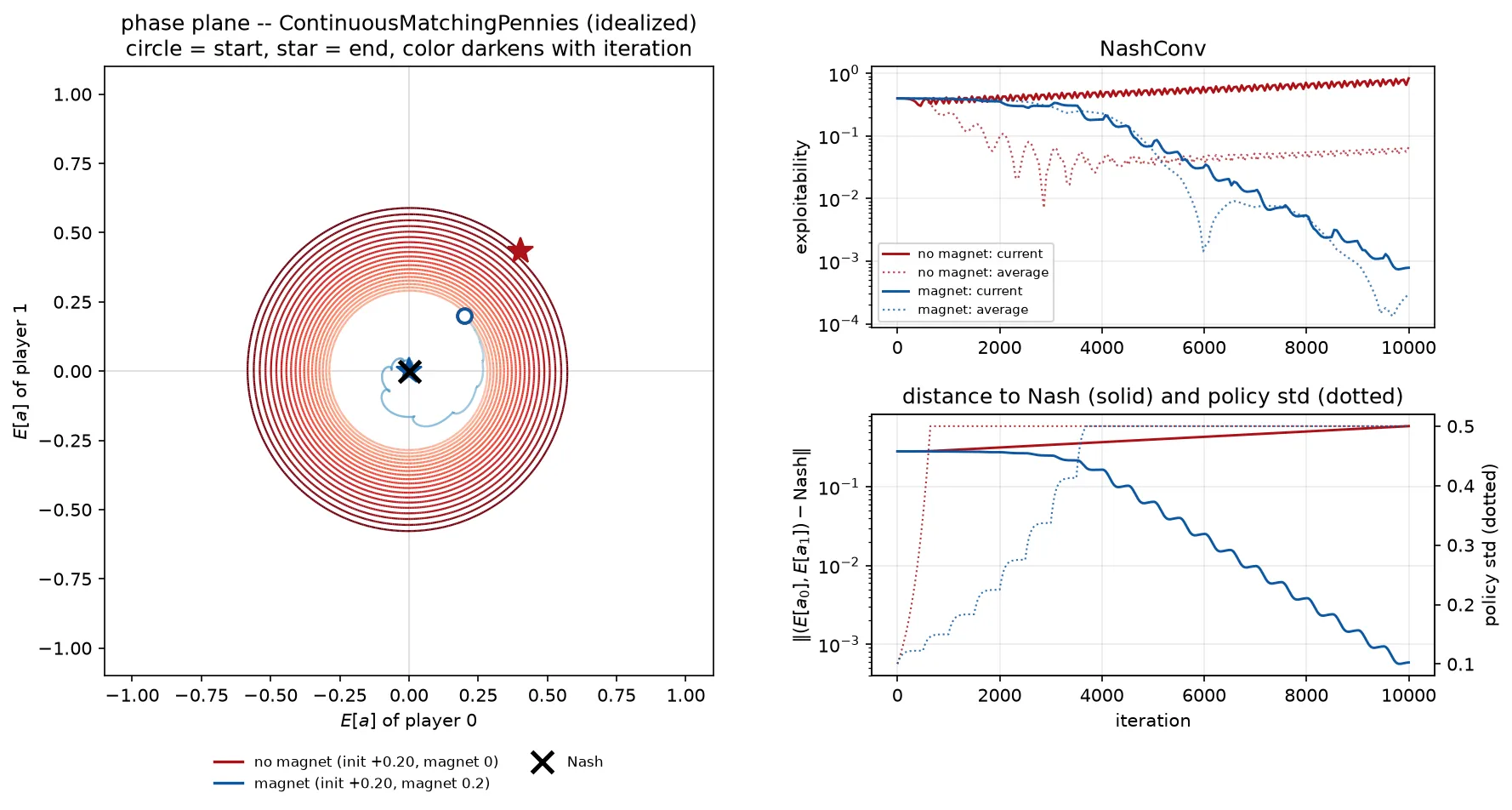
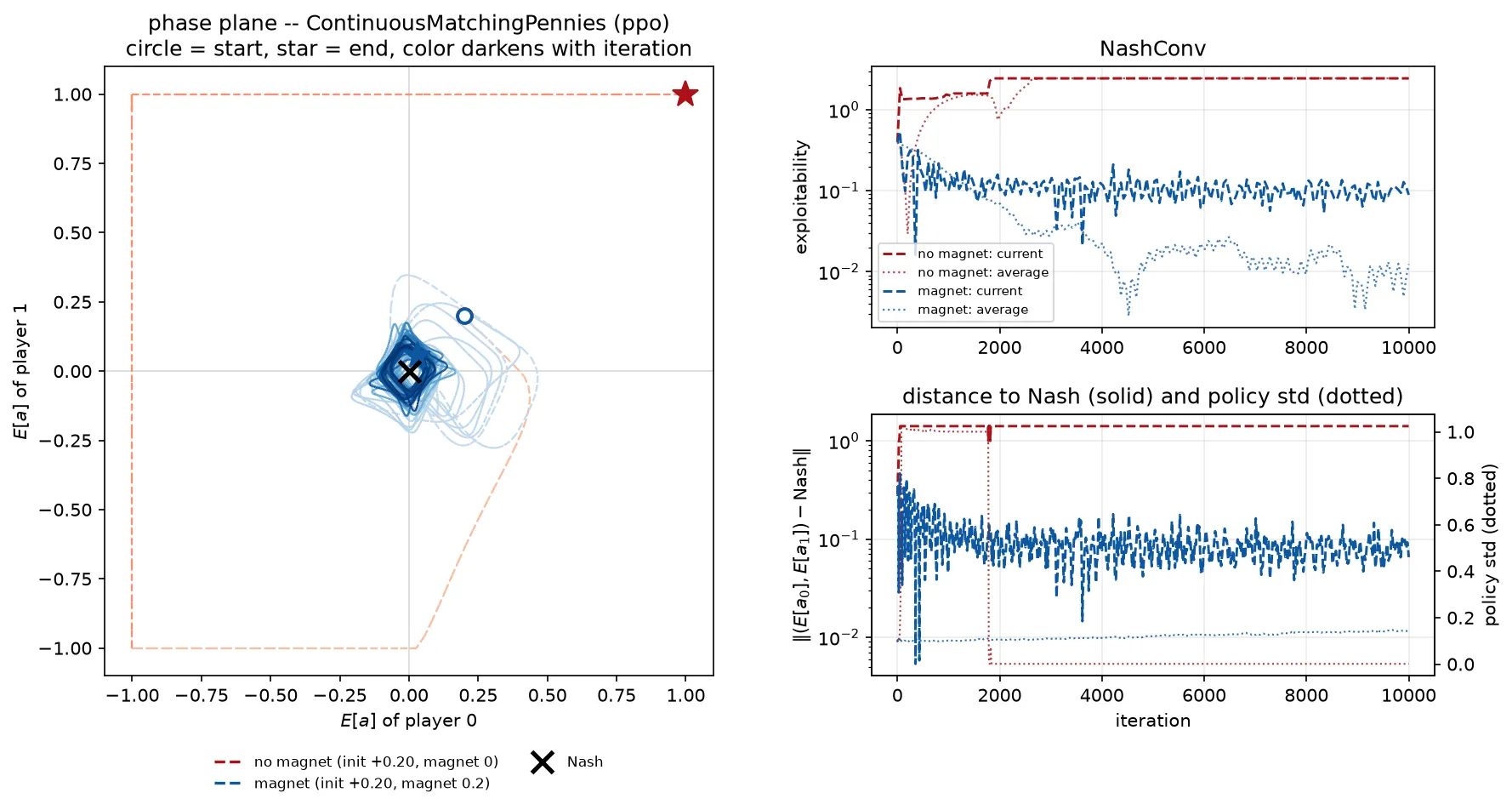
I was else experimenting with the Kuhn and Leduc Poker with continuous bets. Those games are great for our approach, because they combine the continuous and discrete actions and are sequential. Also since they are quite small, we may also be able to get analytical solution, which is nice. From the first experiment on having a discrete bet it seems that the algorithm finds similar quality of the strategy as the vanilla MMD (it shouldn’t be moving the Gaussian head), so I think it passed the sanity check. Weird thing about Leduc with MMD is that there seems to be threshold of roughly 0.35 exploitability. No matter how much you tune hyperparameters I was never able to get any better. Not sure why that is. The game is small enough that I could print the whole strategy and see. But I was lazy to do it, I will probably try this after I finish the work on this paper, as this paper is now a priority.
I am also thinking about some sequential actions. Settings like two player auction, where players bid in some order, and they may change their bids later.
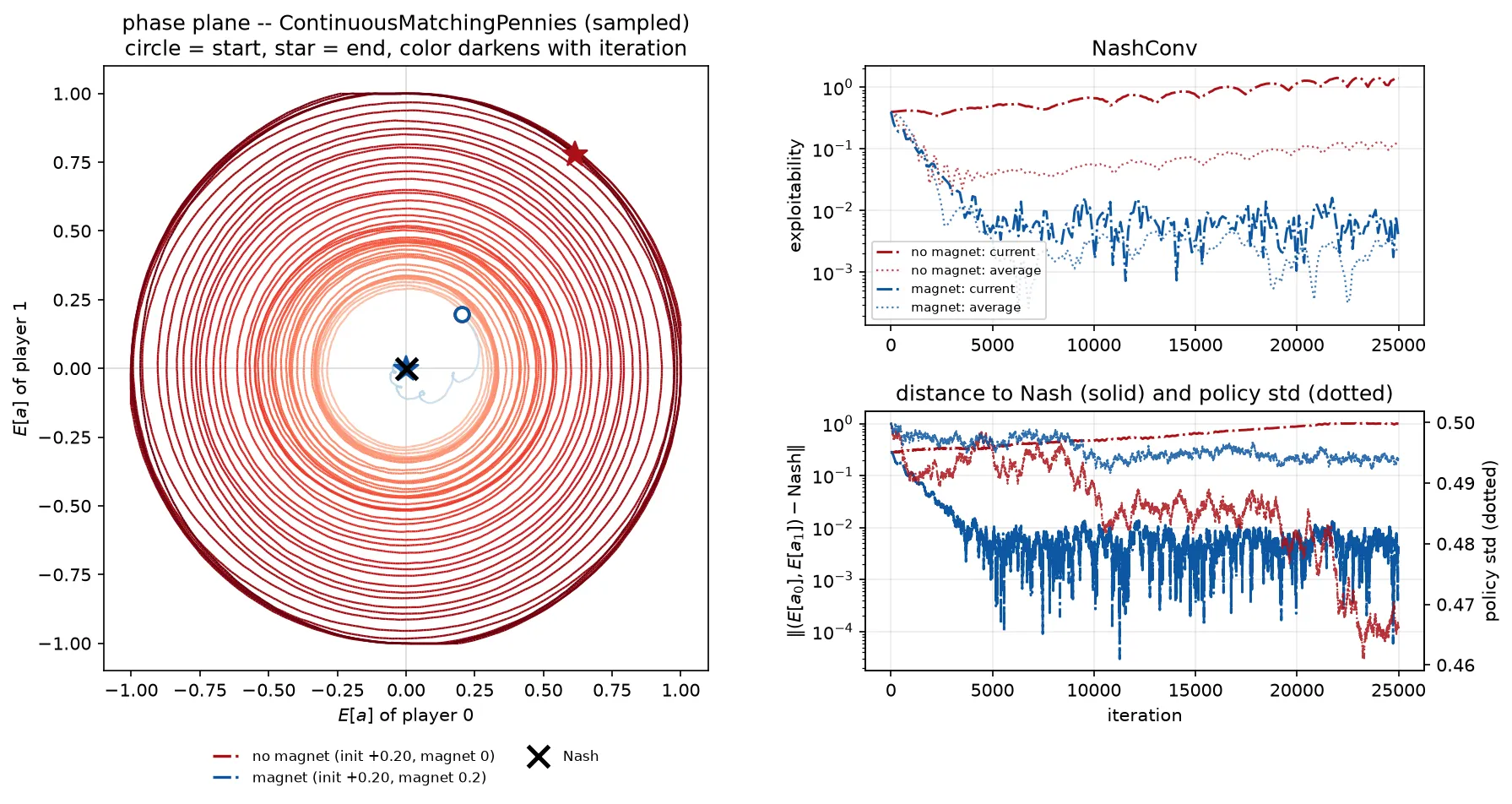
The gradient for the Gaussian head requires computing the integral. So far I tried to estimate it from the neighborhood using the grid (that is why the plots look so nice). I thought that I should try to use Monte Carlo samples instead. That is how the neural version works, so it is a middle-step between those two. Results are still nice.
August 27, 2026
With Gemini, I think I was able to find first draft of the proof for the f(x, y) = xy case. It is possible to derive closed-form solution for the fixed magnet, so this can be used as a building block for the more general proof.
I think that in the case, where you have a pure Nash equilibrium, the function is Lipschitz, the proof will be quite straight-forward. I am in middle of working on it, and I think it can be really similar to that of MMD.
I was optimizing code a bit and running few more experiments. Not sure whether this was always the case or whether there was some change. But Sonnet 5 seems incapable of doing any task right and even if Opus 5 is really good, all of it codes contains so much useless comments that just orienting what the code does becomes a chore. A lot of people are recommending me to try the New GPT 5.6 models and I definitely will give them a try, because Anthropic is losing me.
Also I have started writing the paper. I was thinking that the Gaussian is just a means to an end to get a gradient. But when the magnet gets in and the entropy itself, parametrizing as Gaussian suddenly makes sense.
Most of the day I was writing the paper. I am not good with writing so it was quite slow. But besides that I tried the new Poker checkpoints. The improvements seem to be stagnating in gameplay against older checkpoints. But now I ran against Slumbot head-to-head play and after 25k hands the win-rate is -70 mbb/and. Could be luck, but I checked the strategy for big blind after first bet and it seems much more reasonable than before, let’s see how it goes .
August 26, 2026
When I come back to a codebase after some time, I am always slightly confused about what is going on. This has happened today. In a simple game, it is known that f(x, y)= xy does not converge using gradient ascent descent. So I ran my script that I had prepared over month ago for this, and it did converge. After discussion with Claude it was because of the poor setting, where instead of moving the Gaussian, I used the grid and computed a categorical distribution over this grid, which resulted in very quickly finding Nash. I changed the config, ran it and it did not converge. So I added the magnet, because I recall that with the magnet in the Gaussian space, it worked. I ran the code and it diverged. In that moment I was questioning what I remember and what is true. Luckily I found out that the problem was that I used unbounded variance for the Gaussian and sampling very off can push the dynamics in a way it does not converge. This is a nice observation I should keep in mind when writing the paper. When I limited the variance, everything suddenly worked.
I would like to have a direct proof which says: This is the setting for hyperparameters that needs to be satisfied such that it works. Similarly, the MMD shows that the magnet needs to be greater than a Lipschitz constant. I know that these types of bounds are useless because in the big problems you cannot extract those constants from the problem definition, so you just vibe the hyperparameter and hope for the best. But it makes the result stronger.
August 23, 2026
I implemented the combination of MMD and SAC in my codebase (https://github.com/kubicon/rlg) which I use for experimenting with policy-gradient algorithms and I ran the training in HUNL. Then I again matched it against Slumbot. Good news is that it does not suck as much as the discrete version, but still it loses roughly -0.2 bb/hand. This is not winning! I think the best part about it is that it completely avoids the problem with incompatible abstraction. There is no abstraction now, so during training the algorithm has likely seen all kinds of bets, even those that the Slumbot will make. I still believe this approach.
I tried couple more things, I changed the observations, such that the cards are encoded with transformer, the history is encoded also with transformer etc. It slowed the training, but it does not seem it improved anything. It seems that each new checkpoint is an improvement over the last one, but the improvements are quite marginal, so I am not sure whether I will be to beat Slumbot without algorithmical update. But I will keep the training running, and hopefully the improvements will still continue.
One of my friends, Chris, is working for GTOWizard and they also have their own API for their bot, and I had high hopes that I may be able to beat it. However GTOWizard is winning like 0.2 bb/hand against Slumbot. Sadly I am not close to those numbers. Unlike Slumbot, GTOWizard uses additional search during the gameplay, which makes evaluation against it even slower.
I will keep the training running for one more week. Let’s see what will happen. I can still implement the additional test-time training which I have used in my paper to actually push it more slightly, but I would like to avoid for Slumbot at least, because when you do it, you cannot hunderds-of-thousands hands which I am doing right now.
August 22, 2026
This summarizes all the progress made before starting this blog
My main research focus have beenon imperfect information games. Most of the advances in that field were because of Poker and I’ll be honest. I do not like Poker. Not that I don’t like the game itself, I just don’t like it as a representative research benchmark. I never liked the fact that part of the performance was how good of an abstraction you can do. What should be the card abstraction? What should be the bet abstraction? etc. When I was growing up I saw the success with Atari games and also Go. One can argue that both of them used some abstraction. Atari treated the game as black-and-white and Go used rotational symmetries if I recall correctly. However, in Poker the action abstraction is huge part of the game. Otherwise you would have almost hunderds of actions which differ in 1 chip.
I always thought that better way to treat Poker is to think about it as an continuous action game, where you have a discrete component of fold. Still, I did not want to focus Poker so I avoided it this idea for a time. But for our latest paper (Safe Test-time Reinforcement Learning in Imperfect Information Games) I thought that I would do something I do not like and I’ll use Poker as one of the domains for the experiment. I did even the thing I did not like the most, I used the card abstration. I do not recall which exactly, but it was something like betting 0.5x, 1x, 2x and 4x of the pot. The paper in a nutshell is that you train the neural network in self-play and then during gameplay you continue training that netwrok for couple of seconds to improve the current move. I let the Claude implement the domain itself, I ran the training for 6 days, then I play it and I find out that the ~1000 games I was able to run before the deadline were not even close to get some reasonable statistical significance. It would be require roughly 100-times more even with some variance reduction techniques. So sadly, all this was in vain and I did not include those results in the paper.
But I trained those networks, so why not do something with them right? So, I just took the trained network and matched it against Slumbot, which is public Poker bot, that is not at the top-level, but it is still very strong. I avoided any of the additional test-time reasoning from the paper, I just wanted to have some baseline. I had to fix couple of issues, like when the Slumbot uses an action that is not in my abstraction. I know that this was a huge problem in the Poker in like 2015, so I tried their approaches to mix between the closest bets.
Can you guess how good was the trained network? I will tell you that if you immedietly fold after the small and big blind (which are the mandatory bets), your average reward would be -0.75bb/hand. The bb/hand unit is standartly used in Poker, and most of the time, in AI the small blind is 1 chip, big blind are 2 chips and each player starts with 400 chips (so 200 big blinds). The trained network was losing againt the Slumbot roughly -1bb/hand. It played so horribly, that folding would be a better option. Of course, this is slightly misleading because of the off-abstraction problem, but still, this was really bad.
As most of the people, I do not like losing and I did not want to lose in that spectacular way, so I thought about how to beat slumbot other way. I knew I wanted to avoid the usual CFR approaches, because I have spent quite a lot of my PhD on those, and the implementating it is quite a lot of work to get it right. I know that Claude Code will program it for me, so it wouldn’t be as bad, but people have done this quite a lot since Deepstack/Libratus, I wanted to make it more interesting.
Basically all of my research career revolved around policy-gradient algorithms in imperfect information games (Regularized Nash Dyanmics, Magnetic Mirror Descent), so I wanted to do something with those, but the naive approach I used before just sucked. I started with the initial idea. Let’s treat the actions as continuous, not as a discrete. Then I thought, that single-player reinforcement learning deals quite often with continuous actions, and algorithms like SAC do it by not generating single action, but generating distribution. Specifically, they have a network which or given state outputs 2 values, mean and variance of Gaussian distribution. Then they sample from this distrbution and play that. Training is quite straighforward, because it naturally provides gradient, when you sample from the distrbution you compare whether you improved over your critic, if so you move it closer to that, otherwise you move it further.
In single-player setting, we know that there is optimal strategy with variance = 0 at each decision, which means that you just use the mean. In imperfect information games, this does not hold, because the strategies are often mixed (play several actions with different probability). I think this makes intuitive sense, if you would always have the same bets with the same cards, then it can be exploited if someone notices this pattern. In human-language we would call it bluffing and it is known that the strong bots always employ some form of bluffing. So I thought, let’s take the main idea of SAC, but instead of training single mean and variance for an action, let the network predict multiple means and variances and then train a distribution over them. This seemed so obvious to me, that I had to check whether someone has not did it in the past. I couldn’t find anything (if someone reading this has explored this idea before me, I apologize for not doing my related work check thoroughly). I think it is mainly because imperfect information games are not popular and outside of them, you would just use the vanilla SAC with single mean.
So with this idea I started experimenting. The algorithm in my mind was combination of SAC and Magnetic Mirror Descent (MMD). The main idea is that the network outputs N means and variances and also categorical distribution over those N Gaussian distributions. The categorical head is trained with MMD, which is known to converge in matrix games and the Gaussian head is trained with the SAC loss. MMD uses a concept of magnet, which adds a KL divergence to the loss between this magnet and the current strategy. This may sound like just a hack that prevents large changes, but it can be actually shown that this is necessary to dampen the rotation in the gradients. Because of that, MMD converges to Nash equilibria, wheras PPO does not. I thought that since I am using the magnet already for the categorical loss, I would also use it for the Gaussian loss.
My knowledge of continuous action games is very weak, so I did not know where exactly shall I start. I tried to find some simple games as matching pennies in the continuous setting. But weird thing is that the game called continuous matching pennies do not have mixed equilibrium! I was quite surprised that even finding a well-studied class of games with mixed equilibria in continuous action games is difficult. So I just told Claude to generate a class of games, where I can use a parameter that specifies the position of the actions in the equilibrium support and distirbution across them, and it constructed such a game.
So I tried this in games with multiple equilibria, multi-dimensional inputs etc. and quite suprisingly, it always converged. I was shocked and thought to myself, this is an easy paper. But good things do not last forever, because I told Claude to create a counterexamples where it would not converge. Some counterexamples are obvious, for example if you have a Nash equilibrium that mixes between points -1 and 1, and you initialize both networks at 2, you just never reach the -1 (unless you variance is huge). Or if you have the same Nash, but you create artificial point at -0.5 which serves a a barrier, you also need a sufficient variance to jump over this point.
But even then I thought that these are reasonable constraints, and I should build a theory around it. My theory skills are not that impressive if I am honest, so I wanted to start with Fable 5 and I told him to find me the proof. And oh boy, I was not ready for this. It generated a 20-pages long LaTeX document with theorems and their proofs. I could not even understand what was going on in some parts. Then i spent like a week going back-and-forth with Opus 5 to simplify this in a form that I know what is going on and at the end, the result was maybe too simplified. I understood it, but it seemed like everything was kinda … obvious. Is the paper doomed? I don’t know, hopefully not, but I am not sure whether that is sufficient. ICLR deadline is in 3 weeks now. I think that if I focus, I will be able to do something about it.